If you run a suppressor on a semi-automatic rifle, you'll often hear the same advice: watch the backpressure. Backpressure is the gas a suppressor holds back and pushes toward the shooter and into the rifle, instead of letting it leave out the front. Lower is better, the advice goes, so buy a low-backpressure suppressor and the problem takes care of itself. That's reasonable. A suppressor that holds back less gas changes less about how your rifle behaves, and if you want to put one on and go shooting, it's the safest place to start.
The trouble starts with the next question people ask, which is how low it needs to be. That question treats backpressure as a number the suppressor carries around by itself, with a right answer you could look up. How much it matters depends on the gun the suppressor goes on, and the same suppressor can run fine on one rifle and cause problems on another. Ask it the usual way and you can end up giving up sound reduction and size for a low-backpressure design your rifle never needed. Or you can pass on a suppressor you wanted because someone said your rifle wouldn't run it, when a small adjustment would have fixed that.
It's more useful to think of the rifle and the suppressor as one gas system. How much backpressure you can live with depends on how sensitive your gun is, and on what you're willing to change to make up for it.
A semi-automatic runs on its own gas
A gas-operated gun, like an AR-15, cycles itself using the pressure of the shot. A small amount of gas is tapped from the barrel through a hole called the gas port, and carried back to the bolt carrier group, the moving assembly that pulls the spent case out of the chamber and loads the next round. A buffer and spring behind it push everything forward again.
That works only when the amount of gas is about right, and either direction can interfere with reliable cycling. With too little, the gun may fail to eject or feed. With too much, it cycles faster and harder than it was designed to, which can cause malfunctions of its own, is rough on parts, and sends more gas and fouling back toward your face. The people who designed the rifle picked every part in that chain to balance each other with no suppressor on the end of the barrel.
A suppressor changes how gas moves through that system. It holds gas near the muzzle a little longer, and that shows up in how the rifle cycles. This is what backpressure is, and it's why it's a gun problem as much as a suppressor problem.
Almost every gas-related part is adjustable
On a typical AR, you can change any of these:
- the buffer's weight, and the spring behind it
- the bolt carrier group
- the gas tube, or the gas block, the fitting on the barrel that routes gas from the port into the tube
- the gas port in the barrel
- the ammunition, since different loads produce different pressure
Each one moves the balance, and they trade against each other. A suppressor pushes the balance one way, and any of the others can push it back. With or without a suppressor, getting a gas-powered gun to cycle reliably comes down to finding the right balance among them.
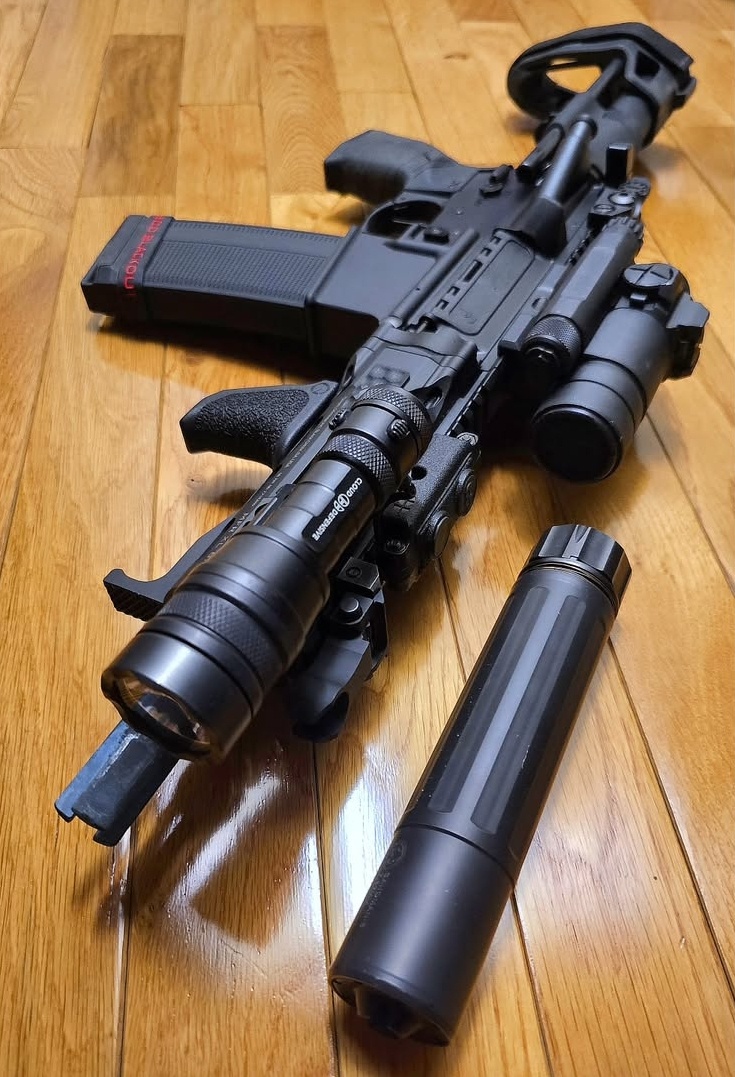
Daniel Defense's DDM4 PDW, a short AR-style pistol in .300 Blackout, shows how this works in practice. It ships with two buffer springs of different strengths, and the right one depends on two things at once: whether a suppressor is on the gun, and whether you're shooting supersonic or subsonic ammunition. Daniel Defense recommends the weaker spring only when the gun is unsuppressed and firing subsonic loads, which give the action less energy to work with. The stronger spring is for unsuppressed supersonic ammunition, and for a suppressed gun with either kind of ammunition. The same gun uses a different part depending on the suppressor and the load, which is what treating it as one system looks like.
Adjusting a handgun instead
Most handguns don't tap gas from the barrel at all. They cycle on recoil, with the slide driven rearward by the shot. Many centerfire handguns also lock the barrel to the slide for a moment and then tilt it down so it frees itself from the slide, while a lot of rimfire handguns, including most .22s, have a fixed barrel and skip that step. A suppressor still changes the balance in either case. It adds weight to the end of the barrel, and it can change how much pressure is left in the barrel when the action starts to open. The handgun's own set of parts can be adjusted to compensate:
- the slide's weight, which changes how fast it moves and how much energy it carries
- the recoil spring's strength, which sets how hard the slide is pushed forward again
- a booster, a spring-loaded piston between the suppressor and the barrel that lets a tilting barrel tilt free under the added weight, and which has a spring of its own. Fixed-barrel handguns don't need one.
- the ammunition, since the power of the load changes how hard the slide is driven
Which direction to adjust depends on whether the suppressed handgun is short of energy to cycle or has more than it needs, so the same part can be lighter on one gun and heavier on another. The idea carries over from the rifle: every one of these parts moves the balance, and the suppressor is one more.
Some guns have more room than others
Every gas-operated gun has a range of conditions in which it cycles reliably, which you can call its operating window. Different guns have wider or narrower windows.
A gun with a wide window may take a suppressor that holds back a fair amount of gas and keep running. A gun with a narrow one may be pushed outside its window by the same suppressor. How much you need a low-backpressure suppressor depends on how sensitive your gun is to the changes the suppressor introduces.
That's also why a single number doesn't settle the question. A backpressure figure describes the suppressor, and the window belongs to the gun. A spec sheet usually won't tell you where your rifle's window ends.
What PEW Science calls it
If you read PEW Science's suppressor reviews, you'll see the word "backpressure" used less than you'd expect. PEW Science is an independent group that publishes measured sound tests of suppressors, and its reviews usually say **flow restriction**, often with "back pressure" in parentheses beside it. Both names point at the same thing: how much a suppressor slows the gas on its way out.
His term describes what happens to the gas, which is also what he measures. His reviews attribute the effects on the gun to the rate gas flows through the suppressor late in the shot, when it's being throttled on its way out, and they describe the suppressor's flow restriction through that late-shot behavior. He puts a number on it, the PEW Science Back Pressure Metric, written with the Greek letter omega and called the Omega Metric. A higher Omega means more flow restriction, and the reviews sort suppressors into numbered Omega zones. Because the number comes from tests on a particular host gun, it describes the suppressor on that gun, which fits the point above: it's a measurement of how a suppressor and a gun behave together.
His reviews also use a rifle's bolt closing time as a signal. He reports that on an AR-15 the change in closing time from the unsuppressed rifle tracks the Omega Metric closely, and he warns readers against reading too much into any single published figure, because the condition of the rifle on test day isn't published.
Choose where you want to make the adjustment
Once you see it as one system, there are two places to make the fix, and which one you pick depends on your priority.
If your priority is keeping the gun reliable without changing anything else, reduce backpressure at the suppressor. That's the straightforward approach, assuming the gun can tolerate that setup. Low-backpressure designs, often marketed as flow-through, vent gas forward instead of holding it back, and they usually give up a little sound reduction to do it.
If you want a specific suppressor that pushes your gun outside its window, adjust other parts of the system to compensate. An adjustable gas block, which lets you control how much gas reaches the bolt carrier group, is the lever people often reach for first, and it's often cheaper than buying a different suppressor. Buffer weight and spring are the next ones to look at.
Neither path is free. The first costs some sound reduction, and the second costs some time spent tuning and a rifle that no longer matches how it left the factory. Baffled lists a backpressure rating where one is on file and has a low-backpressure filter, which is the place to start if you take the first path. The Builder is the tool for checking whether a particular suppressor and mount fit your rifle before you take the second.
Low-backpressure suppressors by cartridge
If you're taking the first path, here are three suppressors to start with for each of the cartridges people most often ask about. They're all built to run with less backpressure, and they're listed at guns.com, a retailer Baffled has an affiliate link with, so a purchase through these links pays Baffled a commission. The full set is on the low-backpressure filter, where you can narrow it by cartridge, length, weight and price.
So, how low?
Low enough that your gun runs with the parts you're willing to leave alone. For a gun with a wide window, that may be most suppressors. For a sensitive one, it may mean a flow-through design. And if the suppressor you want sits outside what your gun tolerates, the rest of the gas system is open to change, so a suppressor you wanted doesn't have to be crossed off just because of one number.