Suppressors, explained.
How suppressors work, how to choose one, and what buying one involves. A suppressor is also called a silencer; the two words mean the same thing.
Looking for how to use the site instead? See the step-by-step guides.
Suppressor basics
The physics, in plain terms.
How a suppressor works
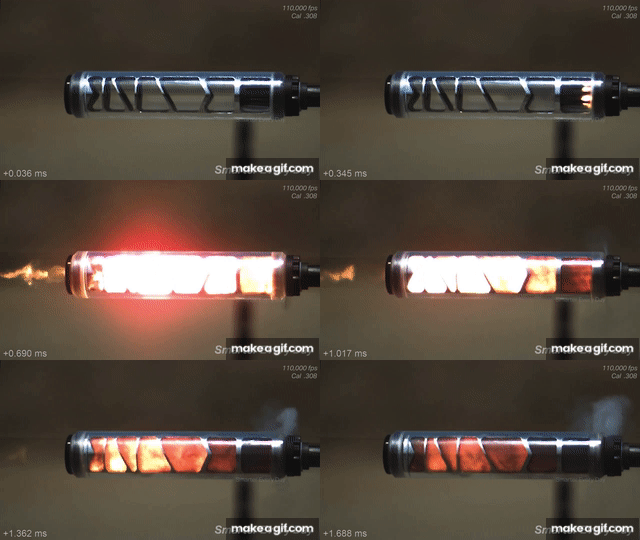
Gunshots are loud because propellant gas leaves the muzzle at enormous pressure, all at once. A suppressor bolts a series of chambers onto the end of the barrel so that gas has somewhere to expand, swirl, and cool before it meets the outside air. Lower exit pressure means a smaller blast, and a smaller blast is a quieter shot. What a suppressor doesn't do is make a gun silent. How quiet you actually end up depends on the gun and the ammunition: a rimfire pistol shooting subsonic ammunition gets genuinely quiet, while a short-barreled rifle stays loud enough that you still want ear protection.
Why would a regular person want a suppressor?
Hearing protection, mostly, and the kind that works at the muzzle so it covers whoever is standing next to you as well. Beyond that: courtesy if you shoot on your own land, an animal's inability to locate a suppressed shot if you hunt, less flinch for someone learning, and the fact that you will not be wearing ear pro if you ever fire a gun inside your house. The full case, including what military blast-injury research changed about it, is a longer read.
What do baffles actually do?
Baffles are the cones or walls stacked inside the tube, each with a hole for the bullet to pass through. Every baffle peels off a share of the gas chasing the bullet and traps it in the chamber behind, where it swirls and sheds heat. By the last baffle the gas has spent most of its pressure, and pressure is what you hear. Baffle geometry is where suppressor designs genuinely differ, which is why two suppressors with identical dimensions can sound nothing alike.
What is backpressure?
Gas the suppressor pushes back toward the shooter instead of out the front. On a semi-automatic it shows up as gas at your face, a dirtier gun, and an action cycling harder than it was designed to. Low-backpressure designs (often marketed as flow-through) vent gas forward instead, usually giving up a little sound performance in trade. Where a suppressor has a backpressure rating on file, Baffled shows it.
How quiet does a suppressed gun really get?
A lot quieter, but nowhere near as quiet as the movies make it sound. When you hear a gunshot, you're actually hearing three sounds. First is the muzzle blast: propellant gas leaves the barrel under enormous pressure and thousands of degrees hot, and it expands violently the moment it hits cool outside air. Second is the supersonic crack, a small sonic boom the bullet drags behind it whenever it travels faster than sound. Third is the action, the mechanical clatter of a bolt unlocking, cycling, and chambering the next round.
A suppressor only works on the first one, and its whole job is to slow that release down: the chambers inside give the hot gas room to expand and cool before it reaches open air, so less of it escapes at once and at lower pressure. That gets you most of the way, because the blast is by far the loudest of the three. An unsuppressed rifle runs around 160 dB at the shooter's ear, loud enough to damage hearing instantly, and a good suppressor takes roughly 20 to 35 dB off.
You will see 140 dB quoted as the hearing-safe line for impulse noise, but treat that as a rough marker rather than a promise. How loud is only half of it. How long and how often you are exposed matters too, so quieter sounds still cost you hearing with enough repetition.
You can do something about the other two, just not with a suppressor. Subsonic ammunition keeps the bullet below the speed of sound, so there is no crack to make. A manual action (bolt, lever, pump, single shot) removes most of the mechanical noise, because you work the action yourself instead of the gun slamming through it under power. Put all three together, a suppressed bolt gun firing subsonics, and that's the setup people picture when they think of a suppressor.
Anything short of that is a partial fix, so think of a suppressor as hearing protection built into the gun and keep wearing ear pro when you can.
What is first-round pop?
The first shot through a suppressor is often a bit louder than the ones that follow. At rest the tube is full of ordinary air, and the oxygen in it combusts with the first shot's unburned powder; later shots pass through oxygen-starved gas and burn quieter. It varies by design, it resets after the suppressor sits a while, and it matters more than spec sheets suggest. If you shoot one careful round at a time, first-round pop is the sound you live with.
Choosing a suppressor
Calibers, materials, and ratings, decoded.
Can one suppressor cover several calibers?
Usually, yes, and it's how most people buy now. A .30-caliber suppressor will happily shoot .308, 6.5mm, .300 BLK, and smaller bores like 5.56 (with the right mount, even 9mm). Two rules govern it: the bullet can be smaller than the bore rating but never bigger, and the cartridge has to stay within the suppressor's pressure rating, which is why manufacturers publish caliber lists. The trade-off is that a dedicated small-bore suppressor is quieter and lighter on that host than a big-bore doing double duty. Baffled's caliber filter works off the largest caliber a suppressor is rated for, so filtering for 9mm shows you 9mm suppressors rather than every .45 that a 9mm bullet also fits through.
What do the materials mean?
It's a weight, durability, and price triangle. Stainless steel is tough and affordable but heavy. Titanium cuts a third or more of the weight and charges you for it. Inconel and similar superalloys tolerate the worst heat and pressure, which is why they show up where designs get abused: blast baffles, short-barrel ratings, full-auto ratings. Aluminum keeps rimfire and some pistol suppressors light and cheap, but it can't take rifle pressures. Plenty of designs mix materials, with a stainless or Inconel baffle where the gas hits first and titanium for everything after.
What's a multi-configuration suppressor?
Some suppressors convert between a long and a short setup, usually by removing a baffle module or swapping the tube. Long buys the best sound numbers; short gives back handiness on a hunting rifle or an SBR. When a suppressor in Baffled has published configurations, the Builder shows a selector for them, and length, weight, and the schematic follow whichever one you pick. The length filter is fair about it too: a suppressor qualifies if any configuration fits under your limit.
What does full-auto rated mean?
It's a durability promise, not a feature. Automatic fire dumps heat into a suppressor faster than any semi-auto shooting schedule, so a full-auto rating means the manufacturer built for that heat, typically with tougher baffle materials and a stated firing schedule buried in the manual. Even if you'll never touch a machine gun, the rating is a useful proxy for how much general abuse a design tolerates, short-barreled hard use included.
Why do some suppressors list a minimum barrel length?
Short barrels send gas into the suppressor at much higher pressure, because the powder has had less room to finish burning and expanding. Every design has a floor below which that pressure starts eroding baffles, so manufacturers publish minimum barrel lengths, usually per caliber. The same suppressor might be approved on a 16-inch 5.56 barrel and prohibited on a 10.3-inch one, so check the restriction against the actual gun you're buying for, not just the caliber.
Mounting & fit
How suppressors attach, and why pistols are special.
Direct-thread vs QD: which should I pick?
Direct-thread screws the suppressor straight onto the barrel: nothing extra to buy, nothing extra to loosen, and the shortest, lightest result. Quick-detach (QD) systems leave a muzzle device on each barrel, so the suppressor locks on and off in seconds and comes back to roughly the same zero. Direct-thread suits a suppressor that lives on one gun. QD earns its extra cost and length the moment one suppressor starts moving between several hosts.
What is the HUB standard?
HUB (Hybrid Universal Base) is a shared 1.375x24 thread at the rear of many modern suppressors. Instead of the suppressor dictating its own mounting system, a HUB suppressor accepts any HUB-threaded mount from any maker: direct-thread inserts, QD adapters, pistol boosters. It's the closest thing the industry has to a universal socket, and it's why Baffled badges HUB on suppressor cards: it tells you the mounting decision stays open after you buy.
What does a thread spec like 5/8x24 mean?
Diameter, then threads per inch: a 5/8x24 muzzle is 5/8 of an inch across with 24 turns to the inch. The two you'll meet constantly are 1/2x28 on most 5.56 rifles and 9mm pistols, and 5/8x24 on most .30-caliber rifles. Mounting is purely mechanical, so compatibility mostly comes down to these numbers agreeing: the mount has to match your barrel's thread on one end and the suppressor's interface on the other. That matching is the part the Builder does for you.
Why do tilting-barrel pistols need a booster?
Most centerfire pistols lock the barrel and slide together for the first moment of recoil, then tilt the barrel down to unlock. Hang a suppressor's weight on that barrel and it can't tilt, so the pistol fails to cycle. A booster (also called a Nielsen device) solves this: a spring-loaded piston between suppressor and barrel that briefly decouples the suppressor's mass and lets the action run normally. Fixed-barrel hosts (rifles, and most .22 pistols) don't need one, which is why the booster question only comes up for centerfire pistols.
Buying & the law
The process, honestly.
How do I actually buy a suppressor?
Suppressors are regulated under the National Firearms Act, so there's paperwork, but the process is more tedious than difficult. You buy from a dealer licensed for NFA items, then submit an ATF Form 4 transfer application: fingerprints, a photo, and a background check, filed electronically through the dealer at most shops today. The suppressor stays at the dealer until the ATF approves the transfer, and then it's yours. The famous $200 transfer tax is gone: it dropped to zero for suppressors on January 1, 2026, though the registration process itself hasn't changed.
How long is the wait?
Anywhere from days to months, and the answer keeps changing. Electronic Form 4s have gotten dramatically faster in recent years, with many approvals coming back within a couple of weeks and some within a day, but times swell whenever application volume spikes. Your dealer sees approvals come through daily and will have a better current read than anything written here.
Are suppressors legal where I live?
Most U.S. states allow suppressor ownership; a handful ban it outright. Hunting with one is a separate, state-by-state question, though the large majority of states that allow ownership now allow suppressed hunting too. These laws move, so check your state's current rules before you start a purchase rather than after.
Trusts
Owning through an entity instead of as an individual.
What is an NFA trust and do I need one?
An NFA trust is a legal entity that owns the suppressor instead of you personally. The practical wins: everyone named as a co-trustee can legally possess and use it (a spouse can take it to the range without you), and the trust settles what happens to it in your estate without a second transfer. The cost is more paperwork up front, since every responsible person on the trust submits fingerprints and a photo with the application. If you're certain you'll be the only user, ever, buying as an individual is simpler and works fine.
Owning & caring
Living with a suppressor.
Do suppressors need cleaning?
Depends entirely on what you feed them. Centerfire rifle suppressors mostly keep themselves clear: the pressure scours carbon out, and many are sealed with no way to open them anyway. Rimfire is the opposite: .22 ammunition sprays lead and wax that harden inside the baffles, and a neglected rimfire suppressor can gain real weight in buildup before seizing shut. That's why rimfire suppressors are built to be taken apart. If you're buying for a .22, confirm the suppressor is user-serviceable first.
Will a suppressor change my point of impact?
Expect your zero to move a little when the suppressor goes on. The added weight changes how the barrel vibrates, so groups print slightly elsewhere. The shift is consistent, and plenty of rifles group better suppressed than bare. Zero with the suppressor mounted if it lives on the gun. A repeatable QD mount is what keeps the shift the same every time the suppressor comes off and goes back on.
Can I travel with my suppressor?
Inside your home state, treat it like any other firearm gear and keep a copy of your approved Form 4 with it. Crossing state lines is fine as long as suppressors are legal where you're headed; unlike short-barreled rifles, suppressors need no advance ATF permission to move between states. Flying means the standard checked-firearm procedure. Taking one out of the country crosses into export law; for practical purposes, don't.
About Baffled's data
Where the numbers come from, and how honest they are.
Where do the specs come from?
Every spec starts from what the manufacturer publishes: product pages, spec sheets, manuals. Where an independent tester such as PEW Science has covered a suppressor, we note the test and link to it, and each point is tagged with its source so you can follow it back. When a manufacturer doesn't publish a number, the field says unpublished. We'd rather show you a gap than invent a plausible-looking value.
What does Confirmed Fit mean in the Builder?
It means the threads and mounting standards of the parts you've picked line up in our data: the mount fits the suppressor, the muzzle device fits the mount, and the specs agree. Treat it as a strong signal rather than a guarantee; manufacturers revise products, and data can lag. Before money changes hands, confirm fitment with the manufacturer or your dealer.
Why do some lengths show ~ or ≤?
A plain number is verified from published specs. A ~ with an est tag means one joint in the build wasn't published, so we estimated its overlap from the mounting standard's known geometry. A ≤ means we couldn't even estimate: the number shown is an upper bound the real build won't exceed. The markers exist so an estimated build can never quietly pose as a measured one.
Why don't all products have photos?
Product images are shown with each manufacturer's permission. We add them as manufacturers grant approval, so coverage grows over time; products without a licensed photo show their specs (and, for a full build, the assembled schematic) instead.
Baffled is a research tool, not legal advice.